Tianjin Haisheng Steel Structure Co., Ltd.
Products
Cold Rolled Z Section Steel Purlins
  • Cold Rolled Z Section Steel PurlinsCold Rolled Z Section Steel Purlins

Cold Rolled Z Section Steel Purlins

Are you looking for a professional and reliable manufacturer of Cold Rolled Z Section Steel Purlins? HAISHENG supports bulk wholesale, custom specifications, and bundled shipping with matching accessories. Our profiles are cold-formed from Q235B hot-dip galvanized steel strip, making them suitable for various steep-slope, long-span steel structure roofs. We offer two tiers of anti-corrosion galvanizing standards tailored for inland and coastal environments. With our own in-house cold-forming production lines, we can simultaneously supply a complete set of installation accessories, including sag rods, flange braces, and purlin cleats.

HAISHENG’s Cold Rolled Z Section Steel Purlins are thin-walled, load-bearing profiles specifically engineered for sloped steel structure roofs. Unlike conventional C-section purlins, their inclined flange structure allows for end-to-end overlapping to form a continuous load-bearing beam, significantly enhancing roof load capacity while reducing steel consumption. As a one-stop steel structure supplier, we offer more than just the Z-section profiles; we provide comprehensive purlin solutions tailored to factors such as factory span, local wind loads, and coastal salt-spray environments. We manage everything from raw material galvanizing quality and in-line punching to the bundled shipment of all supporting accessories, thereby resolving common engineering issues—such as dimensional mismatches, inconsistent anti-corrosion standards, and structural inadequacy during on-site assembly—that arise when sourcing profiles and accessories separately.

Cold Rolled Z Section Steel PurlinsCold Rolled Z Section Steel Purlins

Product Definition and Application Scope

1. Material and Process: 

These Cold Rolled Z Section Steel Purlins are manufactured from Q235B hot-dip galvanized steel strip using a fully automated cold-forming line for continuous roll-forming, resulting in a standard thin-walled, light-gauge steel profile with a Z-shaped cross-section.

2. Primary Application: 

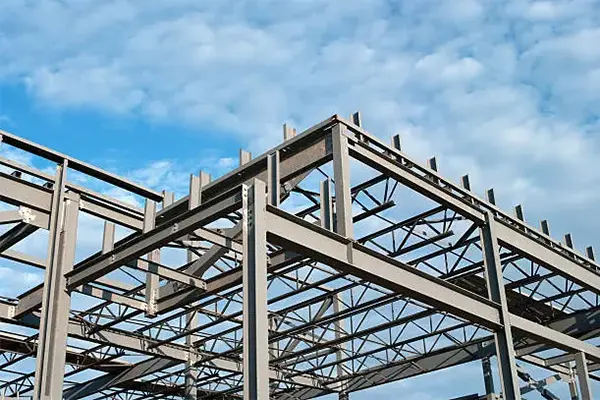
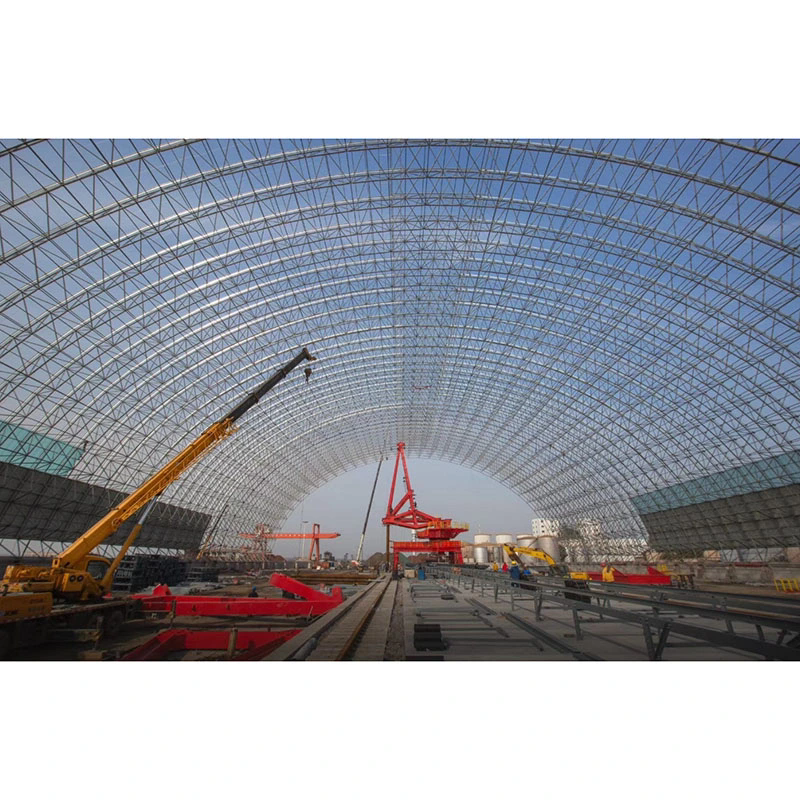
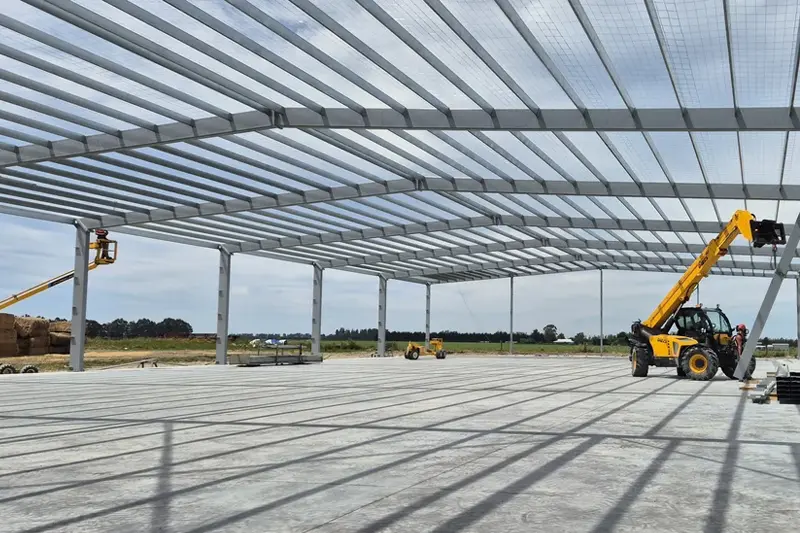
Installed above the main roof beams, they support the full load of the roof's profiled steel sheeting and insulation layers, transferring these loads to the main steel structure. They are widely used in portal frame factory buildings and long-span space frame roofs.

3. Key Structural Features: 

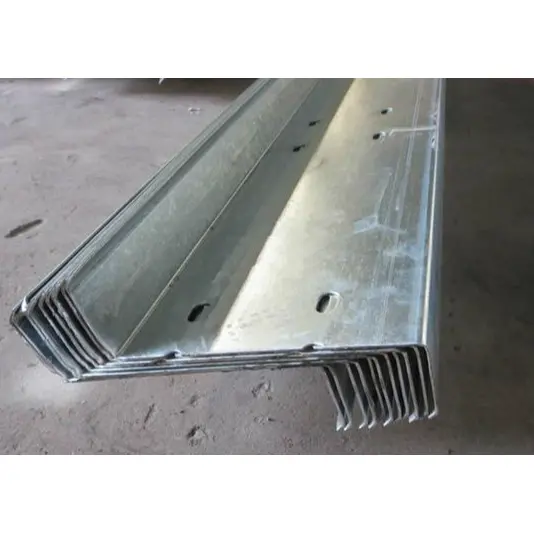
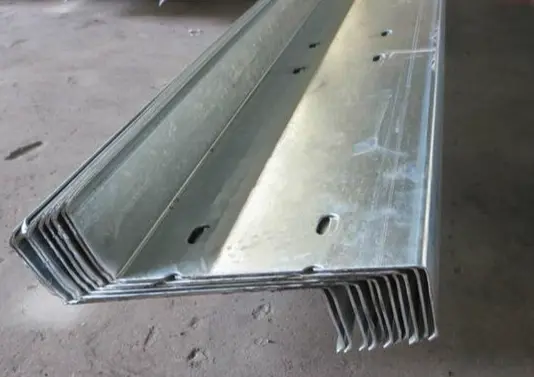
Designed with flanges that slope in opposite directions, the ends can be directly overlapped (staggered) to extend the length, creating a multi-span continuous beam system; this offers superior overall bending resistance compared to C-section purlins. 

4. Usage Restrictions: 

Sloped-flange configurations are unsuitable for the vertical mounting of exterior wall panels; C-sections are the standard choice for load-bearing wall girts, while Z-sections are rarely used for walls.

5. Base Material Corrosion Protection Standard: 

Hot-dip galvanizing is the standard process; the coating thickness must be ≥80μm for standard inland industrial sites and ≥120μm for coastal or chemically corrosive areas.


Complete Supply Package Configuration

1 Main Z-Section Specifications

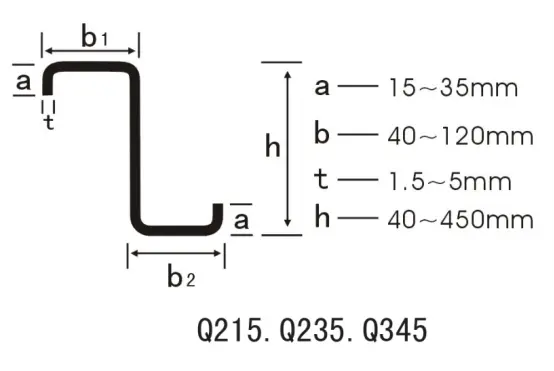
Section designation standard: Height × Flange × Lip (H × B × C)

Standard stock models: Z140×50×20, Z160×50×20, Z180×60×20, Z200×70×20, Z220×75×20, Z250×75×20, Z280×80×20, Z300×80×20

Common wall thickness range: 1.8mm, 2.0mm, 2.2mm, 2.5mm; 3.0mm heavy-duty versions available for custom projects.

2 Lateral Stability Components

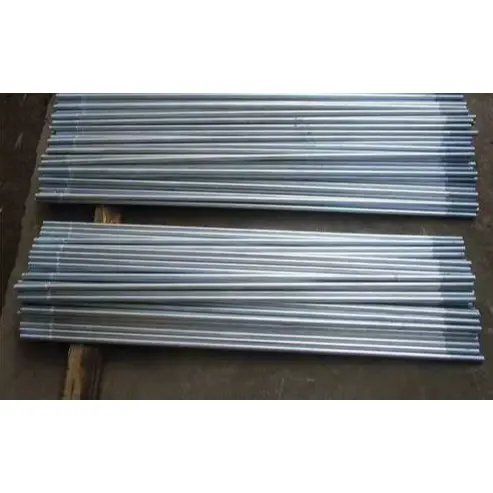
1). Sag rods: Hot-dip galvanized round steel (Φ10, Φ12); available in straight and diagonal types to restrain lateral displacement of Z-sections and prevent twisting or instability under high wind loads.

2). Struts: Hot-dip galvanized welded pipe sleeves (Φ32×2.0); installed at the transition points of diagonal sag rods to provide rigid support, ensuring the rods do not deform under load.

3). Roof flange braces: Small angle steel or small C-section components; fixed to the Z-section purlin at one end and welded to the roof steel beam at the other. These resist purlin overturning caused by strong wind suction; full-roof installation is mandatory for industrial buildings with spans exceeding 18 meters. 

3 Specialized Structural Connection Accessories

1). Purlin Cleats: Hot-dip galvanized steel plates (3.0mm–5.0mm thick) welded in advance to the top surface of the main roof beam; they serve as the base for anchoring Z-section purlins.

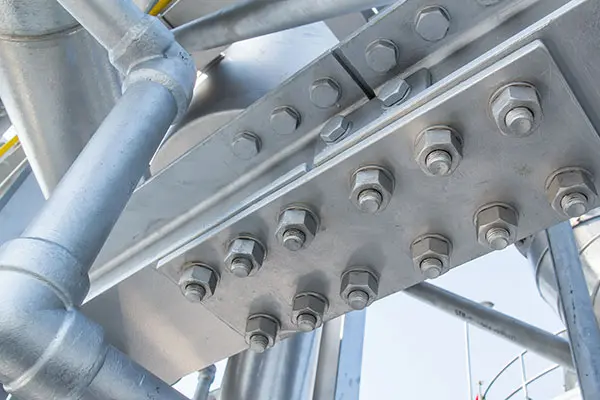
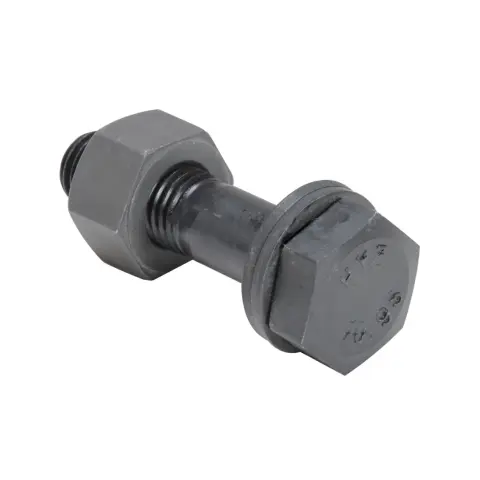
2). Splicing Bolts: M12 or M14 hot-dip galvanized high-strength bolts used to secure the overlapping ends of the purlins.

4 Compatible Upper Roof Enclosure Materials

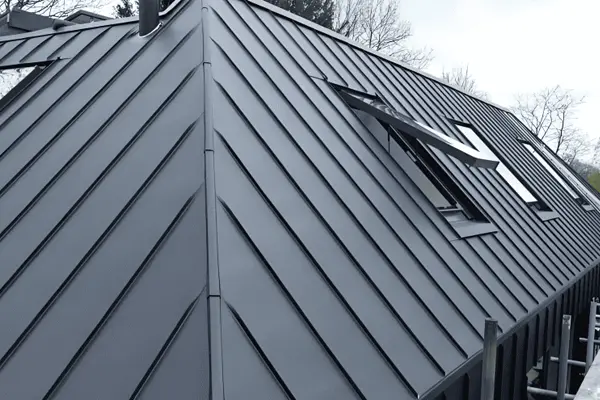
The top surface of the Cold Rolled Z Section Steel Purlins is compatible with 470/475 standing-seam roofing panels and standard profiled color-coated steel sheets. It also supports a complete roof enclosure system that includes thermal insulation, PE breathable membranes, and ridge flashing.


Standardized Purlin Configuration Schemes by Scenario

1 Standard Factory Buildings with Medium Spans (Under 15m)

Uses model Z160×50×20 with a wall thickness of 2.0mm; features standard-spaced sag rods and localized knee braces only at the mid-span of the roof; suitable for inland, ordinary processing warehouses without significant wind erosion.

2 Large-Span Steel Structure Factory Buildings (18m–30m)

Uses models Z180 and Z200 with wall thicknesses of 2.0mm–2.2mm; features a full layout of straight and diagonal sag rods along the entire length and knee braces across the full span to withstand the roof's self-weight and strong wind pressure loads.

3 Coastal High-Wind Areas and Large-Span Space Frame Roofs

Uses thickened Z-section profiles (2.2mm–2.5mm) with closer sag rod spacing and knee braces installed throughout the roof; the galvanizing layer thickness is increased to 120μm to resist marine salt corrosion and gusts of high wind.


Z-Section Steel vs. C-Section Steel

1. Cross-sectional Structure Differences: 

Cold Rolled Z Section Steel Purlins have inclined flanges, allowing the ends to overlap and form a continuous beam structure; C-section steel purlins have flat flanges that can only be butt-jointed, resulting in a simply supported structural behavior. 

2. Application Scenarios: 

Z-section steel is suitable for pitched roofs and long-span applications; C-section steel is commonly used for factory wall girts and roofs with spans of 12 meters or less.

3. Structural Performance: 

With identical cross-sectional dimensions, Z-section steel experiences lower mid-span bending moments, allowing for greater single-span roof distances.


Five Core Practical Advantages

1. Structural Suitability for Pitched Roofs: 

The inclined flanges align naturally with the roof slope, keeping the purlin's top surface parallel to the roof panel; this ensures vertical, uniform load transfer and eliminates eccentric loading.

2. Efficient Overlap Installation: 

The flanges at both ends of the profile can be directly overlapped to extend the length without additional splicing plates; simple bolting completes the extension, significantly reducing roof construction time.

3. Superior Lateral Stability: 

The section offers high overall lateral rigidity and strong resistance to lateral pressure and torsional deformation, ensuring the roof remains stable during high winds.

4. Lightweight and Material-Saving: 

For the same roof span and load requirements, Z-section steel allows for smaller cross-sections or thinner walls, reducing the amount of steel used per unit area and lowering the load on the main steel framework.

5. Convenient Prefabricated Assembly: 

Bolt holes for splicing are pre-drilled at the factory; on-site installation requires only bolt insertion and tightening—eliminating the need for on-site drilling—resulting in secure connections and minimal construction waste.


Key Differentiators vs. Competing Products

1. Continuous Beam Behavior: Material Savings for Long Spans

When overlapped, Cold Rolled Z Section Steel Purlins form a multi-span continuous beam, effectively reducing mid-span bending moments. Under identical load and span conditions, smaller profile specifications can be used compared to C-section steel, lowering overall steel procurement costs. In contrast, C-section steel typically relies on simple-span connections; long-span applications require larger cross-sections, resulting in higher material consumption. 

2 Superior Sectional Bending Strength

Given identical height and wall thickness, the Z-section offers a higher moment of inertia along its strong axis compared to C-section steel. It provides superior vertical load-bearing capacity and resistance to heavy snow and strong winds, making it the preferred choice for coastal projects and large-span space frame structures.

3 Perfectly Suited for Steep-Slope Roofs

The inclined flange structure is naturally compatible with sloped roofs, ensuring stable support without the risk of one-sided, unsupported loading often found with C-sections; the flat flanges of C-sections can cause load eccentricity on steep slopes, leading to deflection and deformation over time.

4 Significant Overall Cost Advantages

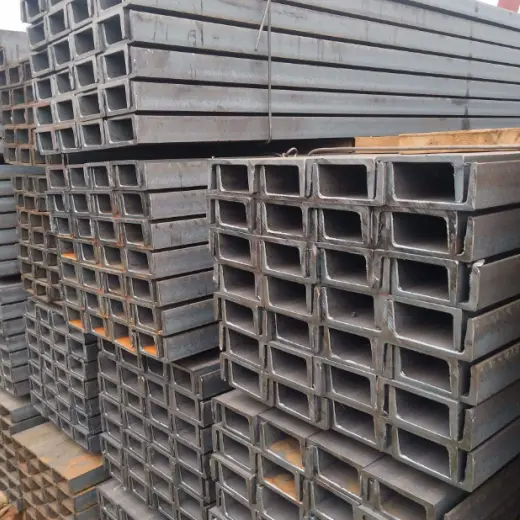
Using Z-section steel for large-span roofs allows for a reduction in profile specifications and total steel consumption. Its self-weight is far lower than that of traditional hot-rolled channel steel; the excessive weight of channel steel not only raises material costs but also increases the expense of main beams and foundation construction, which is why hot-rolled channel steel has largely been phased out for roof purlins in modern light-steel industrial buildings.

5 Dual Advantages: Corrosion Resistance and Long-Span Construction

Manufactured via an integrated hot-dip galvanizing process, it meets dual anti-corrosion standards (80μm for inland areas, 120μm for coastal regions), ensuring resistance to rust during long-term outdoor use. For long roof spans, the sections can be directly lapped to extend the length without segmented splicing, resulting in a much faster overall installation speed compared to the butt-jointing required for C-sections.

6 Summary Comparison with Competing Products

1). C-section purlins: Utilize a simply supported butt-joint structure; suitable for factory wall systems and small-span roofs (under 15m).

2). Hot-rolled channel steel: High self-weight and high cost; rarely used in light-steel envelope systems.

3). Z-section purlins: Allow for lapped, continuous load-bearing and offer excellent bending resistance; specifically designed for steep-slope, large-span roofs. 


Standardized Factory Cold-Forming Production Process

1 Incoming Raw Material Inspection

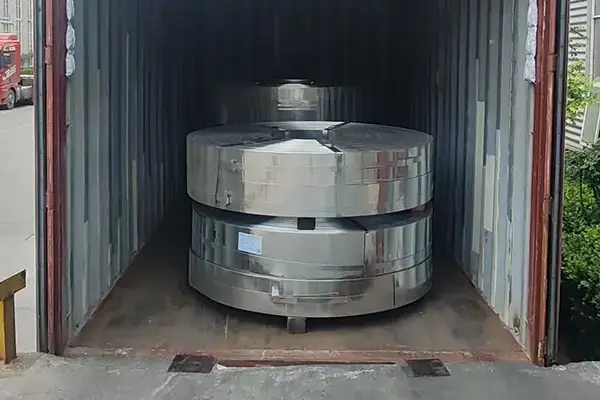
The raw material for Cold Rolled Z Section Steel Purlins is Q235B hot-dip galvanized steel strip. Each batch is verified for strip thickness and galvanizing layer thickness upon arrival; the zinc coating must be at least 80μm for inland applications and 120μm for coastal applications. The surface is inspected for defects such as uncoated spots, peeling, hard bends, or scratches; non-conforming materials are immediately quarantined and excluded from production. Standard production wall thicknesses include 1.8mm, 2.0mm, 2.2mm, and 2.5mm.

2 Uncoiling, Leveling, and Feeding

Steel coils are hoisted onto the loading rack, and the uncoiler releases the strip. Leveling equipment eliminates coiling stress, while the unit is equipped with a dual-side photoelectric correction system to prevent feeding misalignment and ensure uniform cross-sectional dimensions.

3 Continuous Cold-Forming (Core Process)

Multiple sets of forming rollers progressively bend the steel strip, rolling the Z-shape—featuring inclined flanges and inward-curled lips—in a single pass. The process enables mass production of the full standard range from Z140 to Z300; fixed tooling ensures controllable dimensional tolerances.

4 Servo-Driven Flying Saw for Precision Cut-to-Length

The material is cut precisely online to the lengths required by the customer's project. The hydraulic flying saw produces a clean, smooth cut, avoiding cross-sectional deformation from crushing or excessive burrs.

5 End-Lap Punching

Bolt holes are punched at both ends of the profile to facilitate on-site overlapping and bolted connections. Standardized hole spacing eliminates the need for additional drilling during installation.

6 Final Product Inspection

1). Actual measurement of section height, flange width, lip dimensions, and wall thickness to verify conformity with order specifications;

2). Inspection for defects such as side bowing, twisting, or damage to the galvanized coating; defective products are sorted out for rework. 

7 Organized Bundling and Packaging

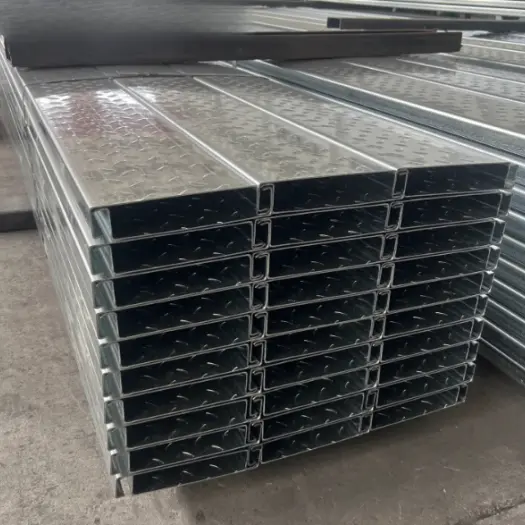
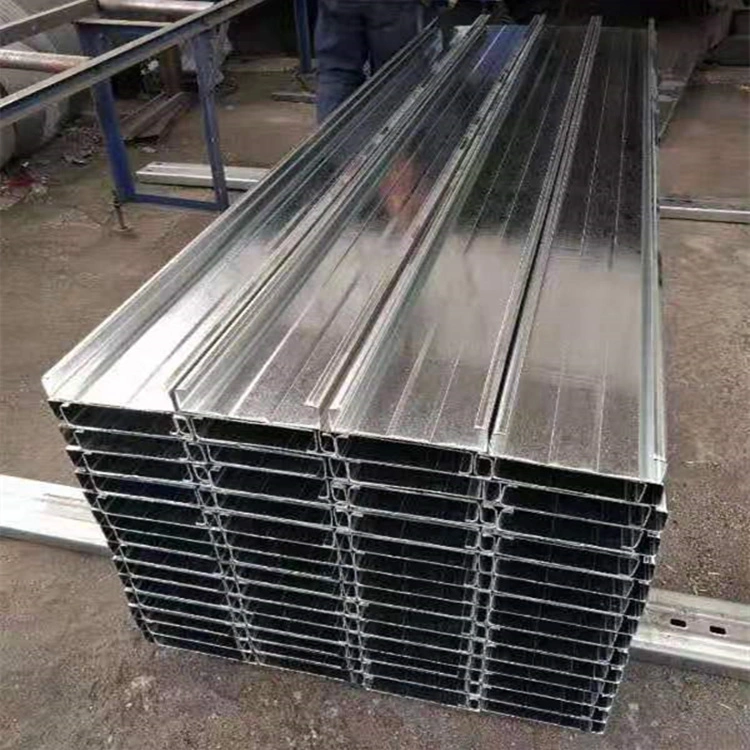
Z-purlins of identical model, wall thickness, and length are bundled together. Wooden pallets are placed at the bottom for protection, and identification labels are affixed, specifying the model, wall thickness, individual length, shipment quantity, and corresponding project name.

8 Simultaneous Processing and Packaging of Auxiliary Components

Complete sets of auxiliary components are processed concurrently: tie rods are fabricated by cutting Φ10/Φ12 round steel, thread-rolling both ends, and applying hot-dip galvanizing; struts are made by cutting and processing Φ32×2.0 welded pipe; and eave braces and purlin cleats are produced via bending. All components undergo galvanizing, are sorted and boxed, and are shipped in the same batch as the Z-purlins.

9 Standardized On-Site Installation Procedures

1). Weld and secure the hot-dip galvanized purlin cleats to the top surface of the roof steel beams;

2). Overlap the ends of the Z-purlins in a staggered arrangement, insert and tighten M12/M14 bolts to form a continuous load-bearing beam;

3). Install straight and diagonal tie rods, utilizing sleeve struts to reinforce lateral stability; install eave braces throughout for long-span roof sections. 


Key Performance Specifications

1 Raw Material Specifications

1). Material Grade: Q235B hot-dip galvanized steel strip

2). Galvanizing Standard: ≥80μm for standard inland areas; ≥120μm for coastal regions and chemical industrial zones

3). Standard Wall Thicknesses: 1.8mm, 2.0mm, 2.2mm, 2.5mm; 3.0mm heavy-duty version available upon request

4). Mechanical Properties: Yield strength ≥235 MPa; tensile strength range 375 MPa–500 MPa

2 Full Range of Cross-Sectional Specifications (H × B × C)

Z140*50*20, Z160*50*20, Z180*60*20, Z200*70*20, Z220*75*20, Z250*75*20, Z280*80*20, Z300*80*20

Usage Note: Z-section steel products are recommended solely for load-bearing roof applications; use as wall purlins is not recommended. 3 Reference for theoretical unit weight of mainstream models (kg/m)

- Z160×50×20: 2.0mm ≈ 4.58kg/m; 2.2mm ≈ 5.03kg/m

- Z180×60×20: 2.0mm ≈ 5.21kg/m; 2.2mm ≈ 5.72kg/m

4 Technical specifications for complete accessory sets

1. Sag rods: Φ10, Φ12 Q235 hot-dip galvanized round steel; ends feature rolled threads;

2. Strut sleeves: Φ32×2.0 seamless steel pipe;

3. Eave braces (knee braces): 1.8mm–2.0mm small C-section steel or angle steel; essential components for high-wind roofs;

4. Connection accessories: Purlin cleats made of 3.0–5.0mm thick hot-dip galvanized steel plate; fixing bolts are M12/M14 hot-dip galvanized high-strength bolts.

5 Selection criteria based on application scenario

1. Small-to-medium span roofs (span ≤ 15m): Z160×50×20, wall thickness 2.0mm;

2. Large-span factory buildings (18–30m): Z180 or Z200 models, wall thickness 2.0–2.2mm; sag rods installed across the full span; eave braces installed continuously along the roof;

3. Coastal areas with high winds and corrosive environments: Select 2.2–2.5mm thicker profiles; reduce sag rod installation spacing; increase galvanizing layer thickness to 120μm.

6 Key structural features

Sloped flanges allow for end-to-end overlapping, creating a continuous beam structural system; for the same cross-sectional dimensions, Cold Rolled Z Section Steel Purlins offer superior bending resistance compared to C-section steel, making them suitable for all large-span, sloped steel structure roofing projects.


FAQ

1. Q: How should I distinguish between and choose between Z-section steel and C-section steel? 

A: Use C-section steel for short-span roofs (under 15m) and load-bearing factory exterior walls; prioritize Z-section steel for pitched roofs, large-span factory buildings (over 18m), and space frame roofs in windy coastal areas.

2. Q: How is corrosion protection ensured for Z-section steel in coastal projects?

A: Orders for coastal regions are manufactured using 120μm thick hot-dip galvanized steel strips; all accessory components—such as sag rods, purlin cleats, and eave braces—undergo the same heavy-duty galvanization process to prevent them from rusting before the main structural sections.

3. Q: Do you offer custom length cutting and supply a complete set of accessories for shipment?

A: We support cutting to any specified length. A full suite of accessories—including sag rods, struts, eave braces, purlin cleats, and connecting bolts—can be matched to the specific factory span and wind load requirements and shipped together in a single container.

4. Q: Can Z-section steel be used directly as wall purlins?

A: It is not recommended; the inclined flanges make it difficult to mount vertical wall panels flush. C-section steel is the standard choice for load-bearing wall purlins.


Hot Tags: Cold Rolled Z Section Steel Purlins, Supplier, Custom, Manufacturer
Send Inquiry
Contact Info
Contact HAISHENG China supplier of Structural Steel Components, Steel Structure Cladding Components and Structural Steel Fasteners. Our professional sales team will reply with detailed quotation, product parameters and delivery plan within 24 hours to meet your bulk procurement demand.
X
We use cookies to offer you a better browsing experience, analyze site traffic and personalize content. By using this site, you agree to our use of cookies.Privacy Policy
RejectAccept