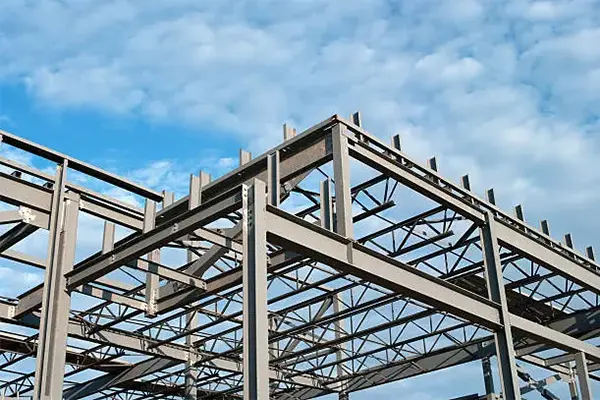
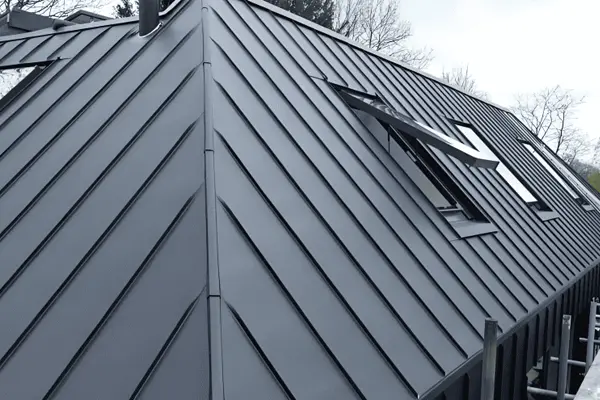
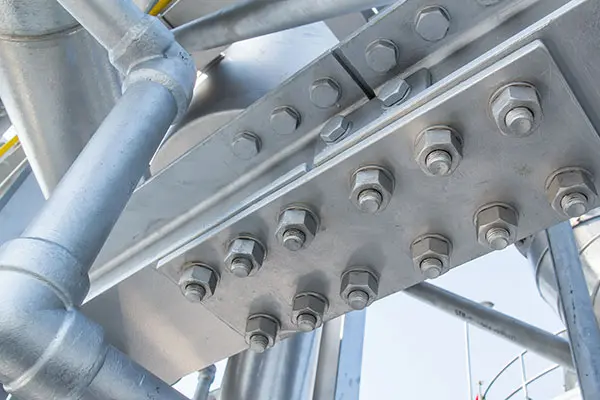
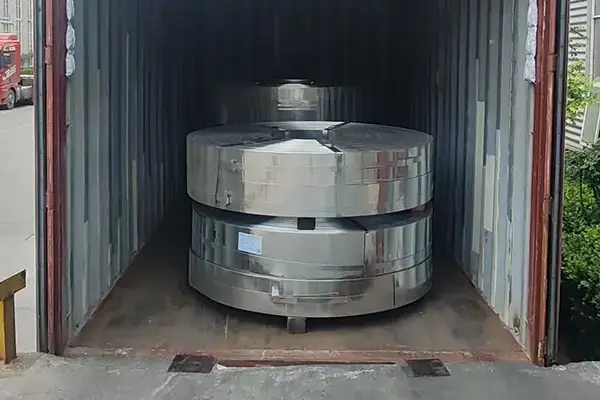
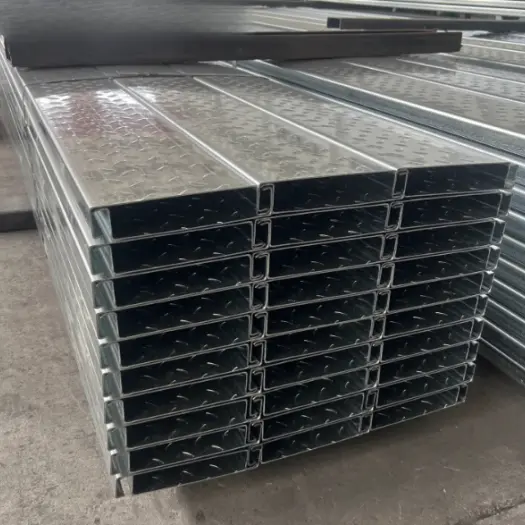
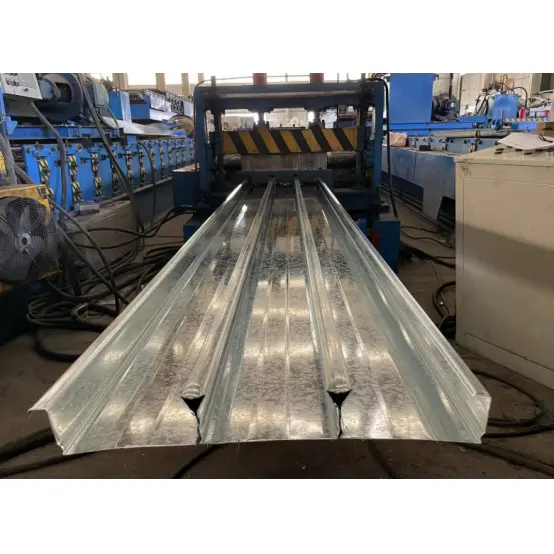
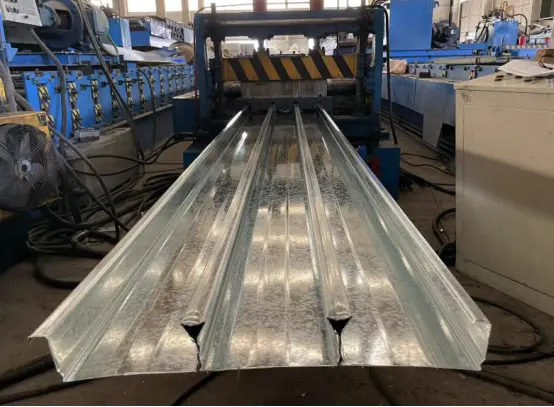
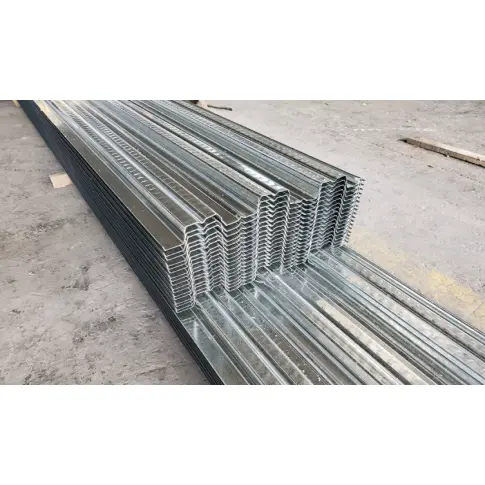
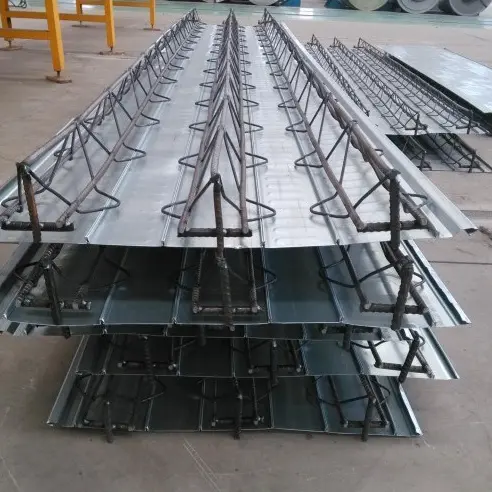
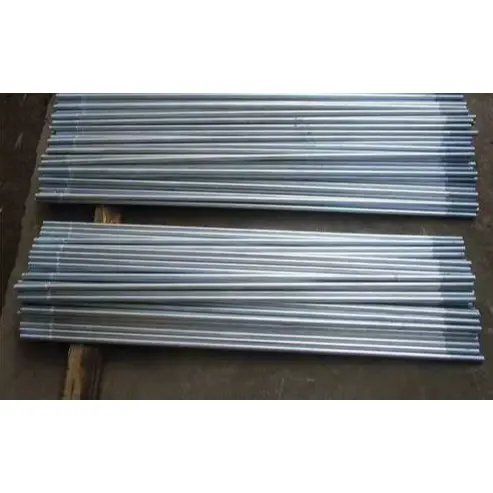
HAISHENG is a specialized manufacturer and supplier of Closed Steel Floor Decking Panels for Buildings. These panels are produced via cold-roll forming using high-zinc hot-dip galvanized steel strips as the base material. Featuring a fully enclosed interlocking cross-section and integrated shear-resistant ribs, they are installed over primary and secondary steel beams. They bond with cast-in-place concrete to form an integrated composite floor slab, serving multiple functions—permanent formwork, primary tensile reinforcement, and fire/sound insulation—making them a premium choice for load-bearing floors in high-rise steel structures.
As a third-generation profiled steel decking product, Closed Steel Floor Decking Panels for Buildings utilize a fully enclosed cavity structure with integrated shear ribs. They can completely replace the bottom tensile reinforcement bars of the floor slab while offering three core advantages: eliminating the need for extensive formwork, allowing for damage-free suspension from the underside, and providing inherent high fire resistance. HAISHENG provides a comprehensive package—including panels, end caps, suspension hardware, and interlocking tools—effectively resolving common construction issues such as component mismatches from piecemeal procurement, inefficient on-site stud welding, damage to the galvanized coating during ceiling installation, and long-term slab rusting or cracking.
Product Definition
1. Closed Steel Floor Decking Panels for Buildings (Code: YXB):
A third-generation permanent profiled steel decking substrate made from high-strength hot-dip galvanized steel strips via cold-roll forming. It features fully enclosed interlocking ribs and pre-formed shear-resistant ribs. During construction, it serves as permanent formwork for cast-in-place concrete; during the service phase, the steel is fully embedded in the concrete to act as the primary tensile reinforcement for the slab's underside, creating a composite steel-concrete load-bearing structure. This design differs from open-rib or semi-open (constricted-opening) rib structures.
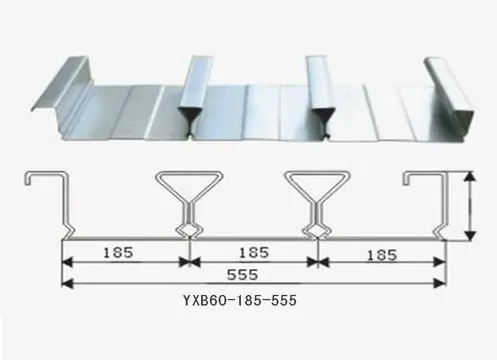
YXB65-170-510, YXB65-185-555, YXB66-240-720 (the three dominant profiles on the market)
3. Base Material Specifications
1) Base Sheet: S350GD/S420GD+Z high-strength hot-dip galvanized steel; yield strength ≥350 MPa; standard thicknesses: 0.75/0.8/1.0/1.2 mm (closed-rib profiles rarely exceed 1.2 mm).
2) Galvanized Coating: Z120 g/m² for inland areas; Z275 g/m² for humid coastal regions; base material standard: GB/T 2518.
3) Structural Features: Fully flat and enclosed bottom; sealed rib cavities; interlocking shear-resistant grooves on the surface; concrete fully encapsulates the rib body; bond and shear resistance are far superior to open-rib profiles.
4. Application Scenarios
High-rise office buildings, commercial complexes, hospitals, data centers, heavy-load equipment platforms, and ceiling projects with dense utility piping.
Heavy industry vibrating floors, underground garage roof slabs, high wind pressure roof slabs
Notes on Panel Thickness Selection: Closed-profile decking offers high structural rigidity; thicknesses exceeding 1.2mm are rarely used on-site. 0.75/0.8mm panels are used for areas with low loads or dense ceiling suspensions; 1.0/1.2mm panels are the standard for high-rise projects; extra-thick panels are available via custom order only (10-working-day lead time).
6. Galvanized Coating Solutions Matched to Environmental Conditions
- Dry indoor environments: Z120g/m² double-sided hot-dip galvanizing; design service life of 28 years.
- Coastal (salt spray) or damp underground spaces: Z275g/m² double-sided hot-dip galvanizing; resistant to chloride ion corrosion.
- Environments with trace chemical corrosives: AZ150 Al-Zn alloy-coated base material; superior acid and alkali resistance compared to standard hot-dip galvanizing.
7. Geometric Dimension Tolerance Table for Mainstream Profiles
Panel Model
Rib Height
Rib Spacing
Effective Width
Raw Material Width
Manufacturing Tolerance
YXB65-170-510
65mm
170mm
510mm
1000mm
Rib height ±0.5mm, width ±2mm
YXB65-185-555
65mm
185mm
555mm
1050mm
Length ±2mm/12m
YXB50-267-800
50mm
266.7mm
800mm
1250mm
Lock seam gap ≤0.2mm
Comprehensive Integrated Support System
3.1 Standard Factory-Supplied Accessories
1. Specialized end caps for closed-profile decking: Includes beam-end caps and side-edge caps; fixed height of 65mm; zinc coating specifications match the decking panels exactly. Installation at beam/slab ends is optional for clear spans ≤2.8m to reduce labor costs (this exemption does not apply to open-profile decking).
2. Custom edge trim components: L-type and Z-type galvanized edge trim (0.6–0.75mm thick); suitable for elevation changes, slab overhangs, and edging around equipment openings.
3. Joint sealing materials: Closed-cell foam sealing strips; inserted into lateral interlocking joints to prevent concrete slurry leakage.
3.2 On-site Structural Connection Accessories
1. Shear connectors: ML15 cylindrical headed studs with ceramic ferrules; Φ16 for 0.75–0.8mm panels; Φ19 for 1.0–1.2mm panels. Stud spacing for closed-profile decks can be increased by 15%; steel consumption is lower than that of open-profile decks.
2. Panel interlocking/fixing: ST6.3 flange self-drilling screws + professional closed-deck seaming pliers; mechanical seaming is used instead of spot welding to protect the galvanized coating on the panel surface.
3. Non-destructive suspension accessories: Dovetail buckle hangers; no drilling or welding required—they snap directly into the closed grooves at the bottom of the panel. Single-point load capacity ≥ 1.2 kN; compatible with fire-rated air ducts, low-voltage cable trays, and suspended ceiling framing.
3.3 Reinforcement and concrete coordination
Unlike open-profile decks, which mandate double-layer reinforcement, closed-profile decks eliminate the need for continuous bottom-layer tensile reinforcement. Only top-layer HRB400 crack-control reinforcement (for negative bending moments) and radial reinforcement around openings are required. Overall steel consumption is reduced by 25%–40%, and all reinforcement designs comply with CECS273 verification requirements.
3.4 Temporary shoring and cut-edge corrosion protection
1. Temporary shoring: Φ48 steel pipe props; support spacing is increased by 0.6–0.8 m compared to open-profile decks of the same thickness, eliminating the need for full-area scaffolding for large floor plates.
2. Cut-edge protection: Plasma cutting consumables + zinc-rich repair paint; all cut edges must be coated with zinc-rich paint to prevent premature rusting at the cut surfaces.
Differentiators from open-profile and reduced-opening (dovetail) floor decks
4.1 Core advantages of Closed Steel Floor Decking Panels for Buildings
1. Cost savings via long spans and formwork-free construction: The box-like closed cavity offers superior flexural rigidity. A 1.0 mm YXB65 panel allows an unsupported span of up to 3.4 m (compared to the 2.5 m limit for open-profile decks), reducing scaffolding rental and erection labor costs by 62% per 10,000 m² of flooring.
2. Cost savings across the entire suspended ceiling process: The underside is completely flat with no protruding ribs, eliminating the need for cement mortar leveling. Non-destructive clip-on hangers prevent damage to the galvanized coating and subsequent rusting, shortening the ceiling installation schedule by 20%.
3. Inherently fire-resistant (no coating required): The ribs are fully encased in concrete; a standard slab thickness of 110mm achieves a fire resistance rating of 1.5–2 hours. High-rise projects do not require fire-resistant coatings, eliminating costs associated with specialized fire safety inspections.
4. Vibration and deformation stability: Closed cross-sections offer superior torsional and wind-suction resistance compared to open trapezoidal profiles; long-term vibration from mechanical rooms or roof slabs will not cause surface depressions or steel delamination.
5. Low on-site leakage and material loss: Dual leak-prevention via mechanical interlocking and sealing strips results in an on-site concrete loss rate of <1%, far lower than the 8%–12% loss rate associated with open-profile decking.
4.2 Drawbacks and on-site remedial solutions
1. Higher unit cost for primary materials: For the same thickness and rib height, the developed width of the raw material is greater, resulting in a higher cost per square meter compared to open-profile decking. Remedy: Savings on reinforcement steel, scaffolding, and the elimination of fire-resistant coatings result in an 8%–12% reduction in total civil construction costs.
2. Difficulty cutting large openings: The enclosed internal cavity prevents direct gas cutting of large openings. Remedy: Factory pre-fabrication of openings for equipment, with only minor openings for piping/conduits made on-site.
3. Low stud welding efficiency: Limited working space within the cavity increases the time required to weld each stud by 12%. Remedial Measures: HAISHENG provides preliminary layout drawings and optimizes stud placement to enhance construction efficiency.
4.3 Final Selection Comparison Table for Three Deck Types
- Open deck: Cost-sensitive projects, high volume of utility penetrations, indoor mezzanines with spans ≤2.5m.
- Closed deck: High-rise public buildings, data centers; requires no formwork; high fire-resistance requirements; large-area suspended ceiling projects.
- Documentation verification: Checking original material of Closed Steel Floor Decking Panels for Buildings certificates from the steel mill and third-party zinc adhesion test reports; rejection of recycled or re-galvanized steel coils.
- Physical spot checks: Random sampling of 1 in every 4 coils to check thickness tolerance, strip camber (curvature), and coating defects (bare spots); entire coils are returned if non-compliant.
- Feeding alignment: Photoelectric automatic alignment uncoiler controls strip deviation to ≤1mm, preventing skewing during forming and interlocking.
5.2 Surface Pre-treatment and Proprietary Pre-punching Process
- Closed-deck specific shear-key punching (a process not found in open-deck production): Continuous punching of shear keys in the web area with ±0.3mm tolerance control, increasing the steel-concrete bond area by over 35%; high-pressure dust removal after punching clears zinc slag from holes to prevent future concrete voids/delamination.
1. Pre-bending (1-6 rollers): Flattening the base plate, pre-forming rib wall angles, and eliminating bending stress.
2. Rib forming (7-10 rollers): Raising rib height to design specifications and reserving allowance for the interlocking fold.
3. Closed locking (11-16 rollers): Bi-directional roll-pressing for the internal interlock seam; seam gap ≤0.2mm, preventing future water leakage or cracking.
- Real-time online CCD visual inspection: Automatic dimensional verification every 30 seconds; non-compliant panels are automatically rejected and prevented from proceeding to subsequent stages.
5.4 Cutting, Finishing, and Final Factory Inspection
- Flying saw cutting: Servo-controlled length cutting; length tolerance ≤±2mm for panels up to 12m; no zinc layer spalling at cut edges; no edge curling.
- Cut-edge corrosion protection: Manual deburring followed by application of zinc-rich touch-up paint on cut surfaces—a mandatory factory process for closed-rib decking.
- Six-item final inspection: Geometric dimensions, seam appearance, coating adhesion, flexural performance, slip resistance, and storage protection; flexural test samples are randomly selected and sent for testing every 5,000 m².
Allowable uniform load(L=3.0m): 9~11kN/㎡(wet concrete + construction live load)
6.3 Core durability and fire parameters
Interface slip resistance: ≥18kN/m, no delamination in long-term use
Fire resistance: 1.5~2.0h without fireproof coating
Service life: 30 years for Z275 coating in coastal non-corrosive environment
FAQ
Q1: Can Closed Steel Floor Decking Panels for Buildings completely replace bottom reinforcement bars?
A: Provided they comply with the JG/T363 standard, S350GD base-material closed-rib panels (65mm rib height) can be calculated as 100% of the primary tensile reinforcement for the slab, allowing for the complete elimination of continuous bottom reinforcement bars without risking drawing approval issues. Only basement roof slabs and uplift-resistant roof slabs require a small amount of supplementary structural bottom reinforcement; standard interior floor slabs do not.
Q2: Will suspending pipelines from the underside of the closed-rib panels damage the slab structure during future maintenance?
A: No. Specialized dovetail clips lock into the closed grooves at the panel bottom without drilling holes or compromising the galvanized coating and the load-bearing cross-section of the steel; pipelines can be repositioned or removed at will. Compliance is maintained for single-point suspension loads up to 1.2 kN; loads exceeding this limit require additional suspension points rather than slab reinforcement.
Q3: How can long-term corrosion protection be achieved for cut edges of closed-rib panels in coastal, high-humidity environments?
A: An initial coat of zinc-rich paint is applied at the factory; a second coat of cold-spray zinc coating must be applied after on-site cutting (ordinary anti-rust paint is prohibited). Additionally, the panel ends overlapping with steel beams must be sealed against corrosion to prevent moisture from entering the rib cavities; this sealing can be inspected concurrently with the main steel structure's corrosion protection.
Q4: How can cold welds be remedied given the limited space for stud welding?
A: The closed rib tops restrict the welding gun angle, resulting in an incomplete fusion rate of approximately 3%–5%. Remedial measures: Replace short ceramic ferrules and adjust welding current parameters; studs with cold welds (incomplete fusion) must be removed and re-welded—patch welding for reinforcement is prohibited.
Q5: At what point do the total costs of closed-profile decking and open-profile decking equalize?
A: Closed-profile decking offers a lower total cost for projects meeting the following criteria: single span > 3m, suspended ceiling area > 70% of the total, and fire resistance requirements ≥ 1.5 hours. Although the unit price of the primary material is higher, savings on scaffolding, fireproof coating, ceiling leveling, and reinforcement steel result in an overall cost reduction of 8%–12%; conversely, open-profile decking offers better cost-effectiveness for small-span mezzanine applications.
Hot Tags: Closed Steel Floor Decking Panels for Buildings, Manufacturer, Supplier, Factory
Contact HAISHENG China supplier of Structural Steel Components, Steel Structure Cladding Components and Structural Steel Fasteners. Our professional sales team will reply with detailed quotation, product parameters and delivery plan within 24 hours to meet your bulk procurement demand.
We use cookies to offer you a better browsing experience, analyze site traffic and personalize content. By using this site, you agree to our use of cookies.Privacy Policy