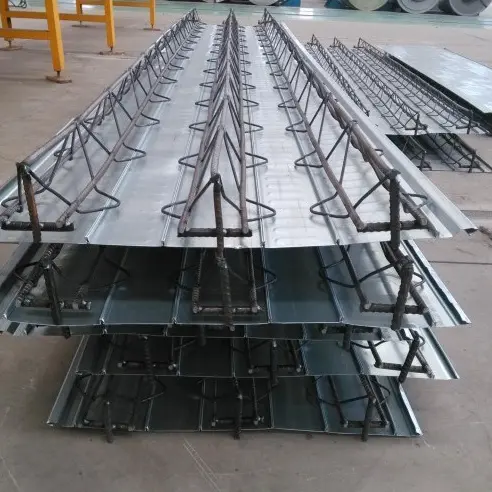
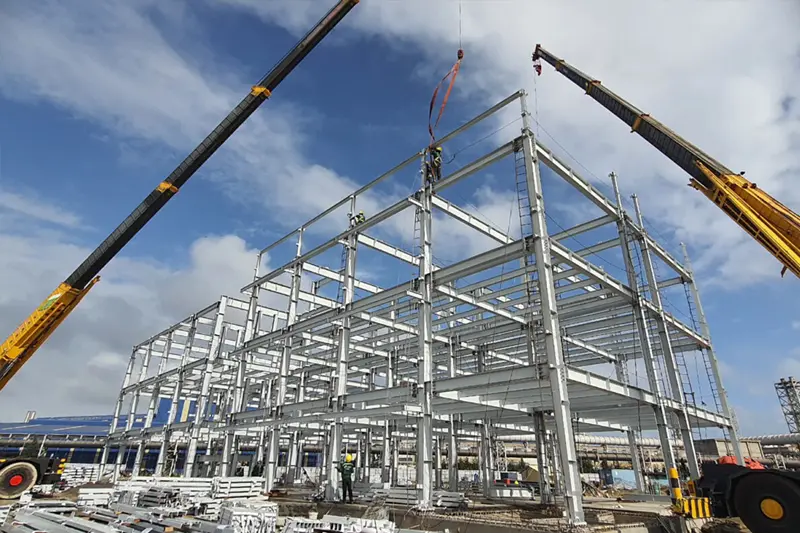
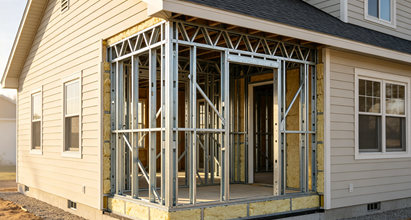
As a direct manufacturer, HAISHENG offers immediate supply of Truss Supported Steel Floor Decking Panels, featuring customizable cut-to-length dimensions, a choice of bottom formwork types, and a complete set of anchoring accessories. These panels are designed for long-span, heavy-load cast-in-place floors; they feature an inherent two-way load-bearing structure that eliminates the need for extensive temporary shoring and comply with national acceptance standards for prefabricated construction.
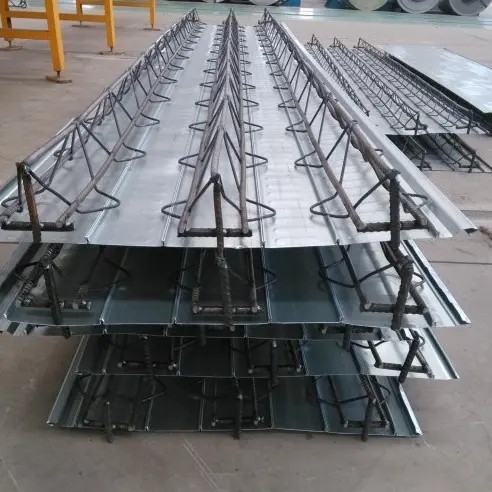
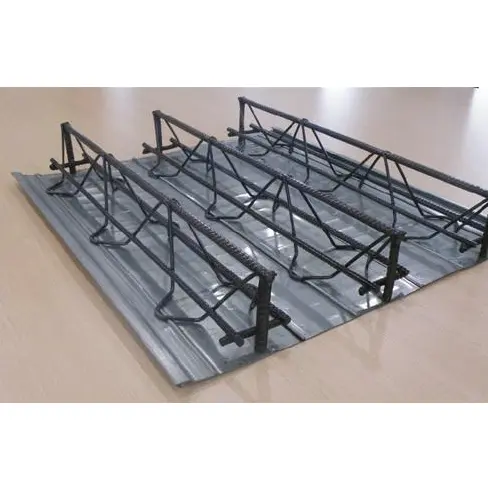
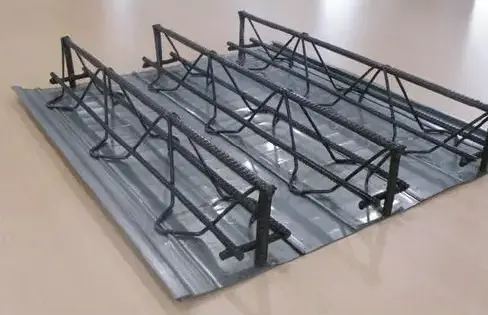
Truss Supported Steel Floor Decking Panels are a mainstream prefabricated component for cast-in-place steel-concrete composite floors. They consist of a triangular rebar truss (formed via automated spot welding) integrated with a permanent or removable bottom formwork. During construction, the panel independently supports the weight of the wet concrete and construction loads; once the concrete cures, the truss reinforcement serves as the primary load-bearing steel for the slab, eliminating the need for extensive on-site rebar tying. Available in three types—removable steel formwork, permanent steel formwork, and permanent inorganic board formwork—these panels meet diverse project requirements regarding corrosion resistance, fire protection, and cost. They are widely used in high-rise steel structures, underground garages, heavy-duty industrial plants, and commercial LOFT mezzanine projects.
List of Compliance Standards
- Product Production & Acceptance: JG/T 368-2012 "Steel Bar Truss Floor Decking"
- Prefabricated Construction Code: T/CECS 1069-2022 "Technical Specification for Application of Prefabricated Steel Bar Truss Floor Decking"
- Slab Deflection & Load Standards: GB 50017 "Standard for Design of Steel Structures"
Product Categories and Application Scope
Truss Supported Steel Floor Decking Panels are categorized into three standard types based on the formwork removal method:
2.1 Removable Galvanized Steel Bottom Formwork Type
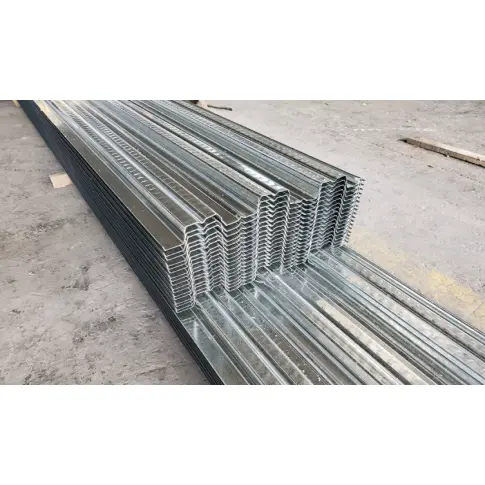
The bottom panel utilizes 0.5–0.7mm S250GD+Z galvanized steel sheet. It is removed and recovered after the concrete reaches design strength, allowing for repeated reuse of the formwork. This type is suitable for standardized multi-story factories and large-scale repetitive mezzanine projects; it lowers the material cost per slab, and the resulting underside is smooth, requiring no additional leveling.
The bottom panel utilizes 0.6–1.0 mm thick galvanized steel, which remains permanently embedded within the floor slab to help resist shrinkage cracking. Suitable for high-rise office buildings and large-span warehouse floors, it eliminates the need for formwork stripping and hoisting, while reducing the risk of slab leakage and cracking.
2.3 Inorganic Permanent Bottom Formwork Variant
Replaces the galvanized bottom panel with 8–12 mm fiber-cement board or foamed cement sheet; the assembly meets Class A non-combustibility standards and carries no risk of steel corrosion. Suitable for residential interiors, enclosed equipment rooms, and floors requiring high fire-resistance ratings; the underside of the panel allows for direct plastering or ceiling suspension.
Factory-Integrated Main Component Specifications
3.1 Triangular Steel Rebar Truss Specifications
Component
Material Standard
Common Specification
Structural Function
Top Chord Reinforcement
HRB400E
Φ8, Φ10, Φ12
Concrete compression bearing
Bottom Chord Reinforcement
HRB400E
Φ8, Φ10, Φ12
Floor tension main reinforcement
Diagonal Web Bar
CRB550/HRB400
Φ4.5, Φ5, Φ6
Shear force transmission, truss stabilization
Support Anchor Bar
HRB400E
Φ10-Φ14
Anti-slip anchorage with steel beam
Standard truss heights: 70/90/100/120/150/180/200/270 mm; total slab thickness = truss height + 30–50 mm upper concrete cover. Standard truss center-to-center spacing is 200 mm; each panel typically features 3–4 trusses.
3.2 Galvanized Bottom Formwork Base Material Specifications
- Base steel grade: S250GD+Z, Q235
- Base steel thickness: 0.5 mm, 0.6 mm, 0.7 mm, 0.8 mm
- Galvanized coating: Z120 g/m² (double-sided) for inland areas; Z275 g/m² (double-sided) for coastal/high-humidity areas
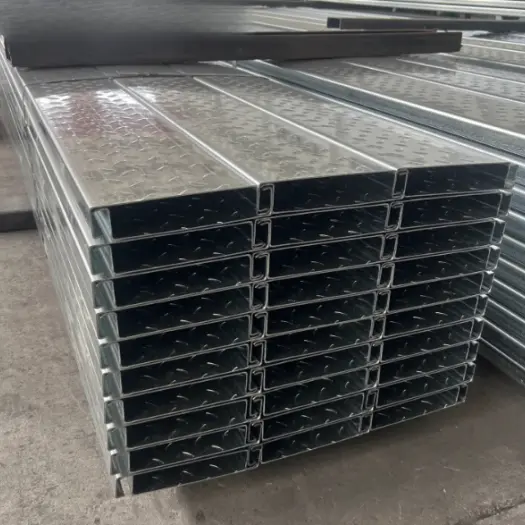
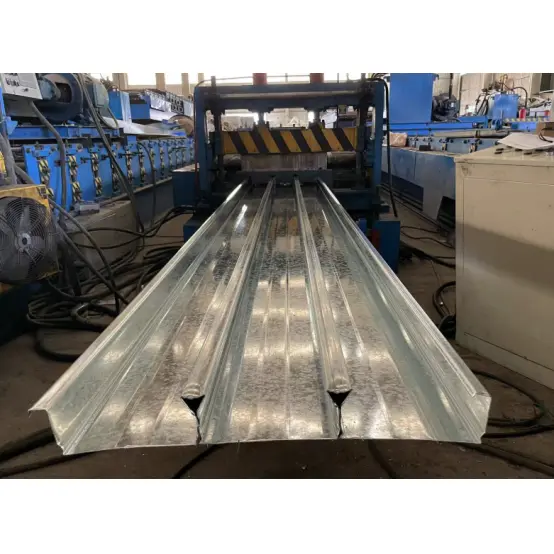
- Panel profile: Micro-ribbed structure with integrated S-shaped interlocking edges; standard effective installation widths of 576 mm and 600 mm
3.3 Factory Composite Welding Standards
The truss bottom chord is joined to the bottom formwork via resistance spot welding; weld points are spaced evenly at 50–75 mm intervals with a single-point shear strength ≥15 kN. Burn-through of the bottom formwork is prohibited to prevent point-source grout leakage during concrete pouring. Inorganic bottom formwork is secured via mechanical interlocking clips rather than high-temperature welding.
List of On-Site Auxiliary Materials and Accessories
4.1 Edge Sealing Accessories
1. L-shaped galvanized steel edge forms: 0.8–1.2 mm thick; used to seal slab edges, openings, and cantilevered sides, preventing concrete overflow and grout leakage.
2. End-cap plates: Made of the same material as the bottom formwork; seal the hollow cavities at both ends of the truss to prevent grout leakage and aggregate loss.
3. Inter-panel sealing strips: Inserted into the interlocking joints between bottom panels to accommodate assembly tolerances and block grout seepage.
4.2 Steel Beam Anchorage Accessories
1. Studs with ceramic ferrules (headed studs): Φ16 and Φ19 specifications; fusion-welded to the steel beam flange to facilitate shear transfer between the slab and the beam.
2. Transverse anchorage bars: Extend 50 mm beyond the slab end and lap onto the top of the steel beam, enabling continuous, collaborative structural action across multi-span slabs.
4.3 Floor Construction Auxiliary Materials
1. Anti-crack distribution reinforcement: HPB300/HRB400 (Φ6–Φ8) spaced at 200–250 mm; counteracts stresses caused by concrete temperature shrinkage.
2. Conduit spacers and rebar chairs: Used to position/elevate MEP conduits and support reinforcement in thickened slab areas, preventing rebar sagging.
4.4 Temporary Construction Components
1. Temporary support joists and vertical props: Installed for spans >3.3 m and removed after concrete reaches required strength; not required for short-span slabs.
2. Embedded lifting loops: Factory-embedded integrated lifting points compatible with tower crane hoisting of entire panels, preventing deformation during lifting.
Comparison of Transverse Performance Across Four Floor Decking Types
Evaluating four core engineering dimensions—structural behavior, unsupported span capability, labor costs, and fireproofing costs—Truss Supported Steel Floor Decking Panels are compared against open-profile, closed-profile, and non-cast (composite-free) decking systems:
5.1 Structural Performance Advantages
1. Bi-directional load-bearing capability: The only precast floor decking that supports cast-in-place bi-directional load-bearing action; suitable for irregular column grids and large cantilevers exceeding 3 meters. In contrast, open-rib and closed-rib decks rely on the steel sheet for uni-directional load-bearing and cannot satisfy bi-directional load verification requirements.
2. Maximum unsupported span: The TD series supports unsupported spans of up to 6.0 meters, far exceeding the limits of closed-rib decks (2.8–3.5m) and open-rib decks (2.0–2.8m), thereby reducing the required number of primary and secondary beams.
3. Vibration stability: Features an integrated solid reinforced concrete structure with low natural vibration amplitude; suitable for facilities with vibrating equipment or heavy-load warehouse floors, ensuring no surface delamination or cracking during long-term use.
5.2 On-site Construction Differences
1. Labor savings: Main reinforcement is 100% factory-prefabricated, requiring only the placement of top distribution bars on-site; this reduces on-site rebar tying labor by over 70% and avoids common issues such as rebar displacement or insufficient concrete cover associated with manual tying.
2. Reduction in formwork and scaffolding: Permanent bottom formwork replaces timber formwork; no full-area scaffolding is required for spans ≤3.6m, and multi-story steel structures allow for phased, continuous construction, shortening the overall schedule by 30%–50%.
3. Utility installation compatibility: The triangular truss creates organized open voids, allowing plumbing and electrical lines to pass through horizontally without cutting the main floor structure; conversely, closed-rib or non-concrete-filled decks have limited internal space, making utility penetrations likely to compromise the structural cross-section.
5.3 Fire Resistance and Cost Differences
1. Inherent fire resistance: Load-bearing reinforcement is fully encased in concrete, providing an inherent fire resistance rating of 1.5–2 hours without the need for fire-retardant coatings on the underside; open-rib and closed-rib decks require full or partial fire-retardant spraying, while non-concrete-filled steel decks require rock wool infill to meet standards.
2. Full-lifecycle cost: While the unit price of the bare panel is higher than that of open-profile decking, the comprehensive cost for long-span projects is 8–12% lower than that of closed-profile decking and approximately 15% lower than that of pour-free all-steel decking—after deducting costs for formwork, scaffolding, fireproof coating, and rebar labor.
5.4 Limitations and On-site Solutions
1. Limitation 1: The self-weight of individual panels is higher than that of standard profiled decking, limiting the number of panels that can be hoisted at once for high-rise projects. Solution: Cut panels to specific lengths in sections and hoist them in staggered batches to avoid disrupting the overall installation schedule.
2. Limitation 2: Cutting flexibility for irregular corners and edges is lower than that of open-profile decking. Solution: Perform irregular cutting via CNC at the factory, with only minor trimming required on-site.
Fully Automated Standardized Production Process
6.1 Raw Material Incoming Inspection
Verify rebar heat number quality certificates and galvanized coil coating test reports; conduct random re-testing of rebar yield strength and galvanized coating adhesion. Reject materials showing rust, coating defects, or deformation; simultaneously generate production parameters for cutting and truss height based on construction drawings.
6.2 CNC Rebar Straightening and Cutting
Straighten coiled rebar to a straightness tolerance of ≤2mm/m and cut to uniform panel lengths (length tolerance controlled within ±3mm); stack top/bottom chord bars and web bars in separate zones to prevent mixing errors.
6.3 Galvanized Base Panel Roll Forming
After uncoiling, leveling, and dedusting, the galvanized steel strip undergoes continuous micro-rib roll forming; edges are formed into S-shaped interlocking joints. Base panel length and width tolerances are ±3mm and ±2mm, respectively; plasma cutting for irregular openings is performed simultaneously.
6.4 Automatic Spot Welding and Assembly of Triangular Trusses
Position top and bottom chord bars using a dual-track system (centerline deviation ≤±5mm); automatically feed V-shaped web bars at equal intervals. Spot weld using high-frequency current (17–19 kA) and welding pressure (0.32–0.38 MPa) to eliminate cold welds and rebar over-burning.
6.5 Assembly of Truss and Bottom Formwork
Mechanical tooling is used to position the truss spacing, and spot welds connect the bottom chord reinforcement to the bottom steel sheet at intervals; inorganic bottom formwork panels are secured using clips to avoid damaging the fire-resistant structure of the inorganic material.
6.6 Precision Finishing of Ends
Installation of end caps and bearing anchorage reinforcement; reinforcement of side edges; installation of supplementary annular reinforcement around openings to eliminate the risk of stress cracking at the ends.
6.7 Multi-stage Factory Quality Inspection
1. Visual Inspection: No peeling of the galvanized coating, twisted reinforcement, or punctures in the bottom sheet; surface flatness deviation ≤5mm over a 2m span.
2. Dimensional Verification: 100% inspection of truss height (tolerance ±2mm) and panel length (tolerance ±3mm).
3. Mechanical Spot Checks: Weld peel tests per shift; load-deflection tests on floor panels per batch.
4. Defect Repair: Application of zinc-rich repair paint to scratched areas on the bottom sheet; dry film thickness ≥100μm.
6.8 Storage, Packaging, and Shipment
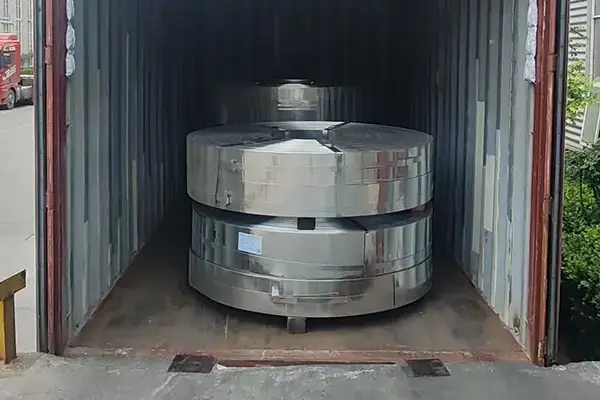
Truss Supported Steel Floor Decking Panels are stacked in layers on timber dunnage; edge protectors are installed to prevent impact damage during lifting; the stack is wrapped in a rainproof outer film; shipments include the certificate of conformity, material quality report, and factory inspection records.
Key Mechanical Parameters for Engineering Selection
1 Unsupported Clear Span of TD Series
Panel Model
Truss Height
Max Span(0.7mm steel base)
TD70
70mm
3.3m
TD90
90mm
3.8m
TD120
120mm
4.5m
TD150
150mm
5.2m
2 Load and Deflection Standard
Dead weight(without concrete): 12-18kg/㎡(TD70-TD120)
Office live load: 2.5kN/㎡; Warehouse live load: 3.0-5.0kN/㎡
Heavy equipment floor live load: 6.0-10.0kN/㎡(reinforced)
Deflection limit: ≤L/250 under normal service condition
- Heavy-duty industrial plants & equipment floors: TD180/TD200; customized truss spacing (closer intervals) to enhance local compressive load-bearing capacity.
- Residential interiors & high fire-rating zones: Inorganic fiber permanent bottom formwork; meets Class A fire-rating requirements for interior plastering.
FAQ
Q1: Will the bottom sheet deform or bulge during concrete pouring?
A: With compliant weld point spacing, bulging does not occur. Factory weld spacing is strictly controlled at 50–75mm, and the bottom sheet's micro-rib structure resists lateral pressure. Elastic deflection occurs only if the span exceeds the limit for unpropped construction without temporary supports; this is easily avoided by installing vertical supports as per specifications.
Q2: Does the galvanized coating on the slab underside require additional anti-corrosion treatment after removing the removable bottom formwork?
A: No. After removing the formwork, the slab underside is a raw concrete surface with no exposed steel, so there is no risk of rust. Unlike permanent steel formwork, no subsequent anti-corrosion maintenance is required.
Q3: What is the maximum cantilever length, and is extra reinforcement needed?
A: Standard truss decks allow a maximum single-sided cantilever of 3m. For cantilevers between 1.5m and 3m, simply increase the density of top distribution reinforcement and add an edge closure beam; increasing truss height is unnecessary. Cantilevers exceeding 3m require customized taller trusses and inclined anchor reinforcement.
Q4: Which type of bottom formwork is more durable for coastal environments with salt spray?
A: Prioritize the use of Z275 galvanized permanent steel formwork (which does not require stripping), as the coating withstands salt spray for over 2,000 hours. Removable formwork is prohibited for coastal projects exposed to high salt spray to prevent corrosion at steel beam anchorage points after removal; inorganic permanent formwork is unaffected by salt spray and is suitable for general use.
Q5: Which is easier to get approved: drawings for Truss Supported Steel Floor Decking Panels or for closed-profile steel floor decking?
A: Truss-supported steel floor decking panels have a higher approval success rate; they are directly included in the national standard atlas 22G522, so design institutes do not need to perform additional specialized structural verification. In contrast, closed-profile profiled steel decking requires separate verification of steel-concrete slip resistance, and the approval process for irregularly shaped floor plans takes longer.
Contact HAISHENG China supplier of Structural Steel Components, Steel Structure Cladding Components and Structural Steel Fasteners. Our professional sales team will reply with detailed quotation, product parameters and delivery plan within 24 hours to meet your bulk procurement demand.
We use cookies to offer you a better browsing experience, analyze site traffic and personalize content. By using this site, you agree to our use of cookies.Privacy Policy